
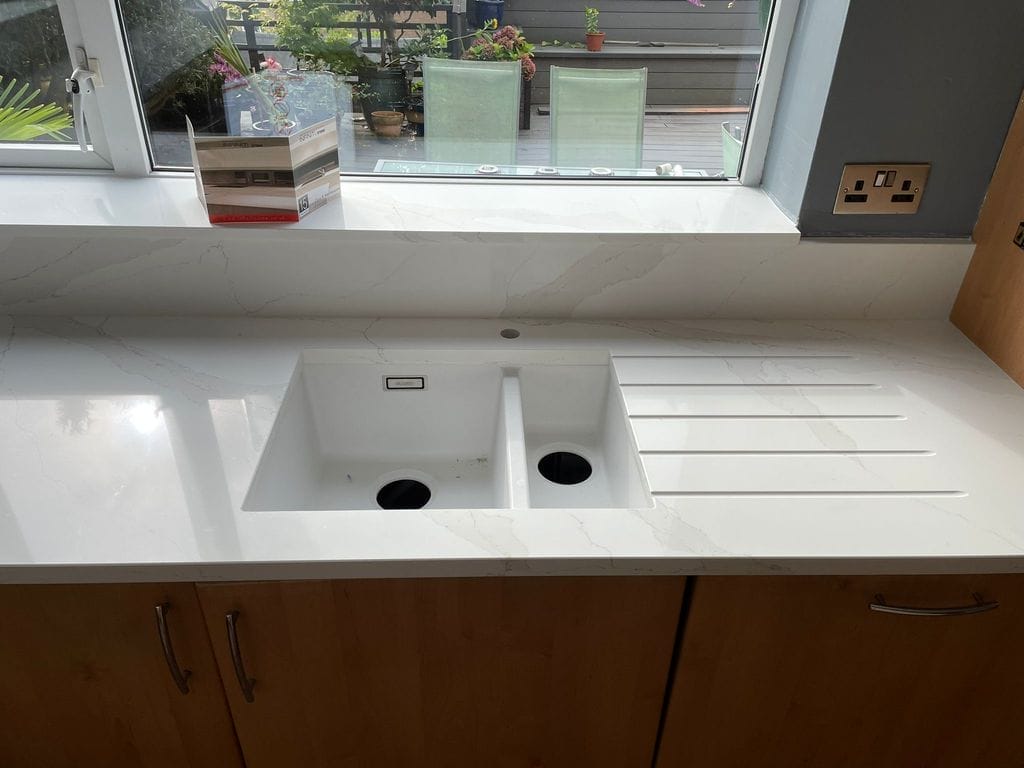
In our experience, most worktop mistakes don’t start in the workshop. They start on template day, when decisions get made or changed while the templater is measuring. Moving the drainer grooves from left to right sounds like a small change, but if it doesn’t get passed all the way through, it can cost a few thousand pounds to put right. The way to avoid it is to have every decision made and agreed before worktop templating, and to leave it alone once the templater is on site.
This guide is mainly for kitchen companies and fitters, but it’s just as useful if you’re a homeowner having a new kitchen fitted. It covers who’s involved, where things go wrong and what needs deciding before we arrive.
Why communication is the biggest risk in worktop templating
A worktop passes through a lot of hands before it’s fitted, and something can get lost at every handover.
On a typical job, the chain looks like this:
- The designer creates the kitchen and decides what it should look like.
- The kitchen fitter has to make that design work on site.
- Our templater comes out to measure for the worktop.
- Our fabrication team makes the worktop to those measurements.
- The installer fits it, matching everything back to the original design.
If the loop isn’t closed at every one of those stages, that’s where errors happen. Each person works from what they were told. If the design changed along the way and the change didn’t travel with it, the worktop gets made perfectly to the wrong brief.
That’s why we want the design intent clear from the start: what the finished kitchen should look like, what you’re trying to achieve and every detail that affects the worktop. When that’s agreed and passed on before we measure, jobs run smoothly. When it isn’t, problems turn up later, when they cost far more to fix.
The template day change that can cost thousands
Here’s how one small change on the day turns into an expensive mistake.
Our templater arrives to measure a job. The customer wants the drainer grooves on the left-hand side, so he starts templating to that.
Meanwhile, the customer rings their partner, or their partner rings them, and the answer comes back: no, put them on the right. So they ask the templater, “Can we just change that from left to right now?”
It sounds like a two-second job. But the templater has several more jobs to get to that day, and that one change has to be noted, understood and processed correctly all the way through to the workshop and the installer. If it’s missed at any point, the worktop gets made with the grooves on the wrong side. On a stone or porcelain worktop, that can cost a few thousand pounds to put right.
Nobody in that story did anything unreasonable. People change their minds. The problem is the timing. A decision made before the visit goes on the drawing and travels through the whole process. A decision made mid-measure relies on everyone remembering it.

What to decide before your worktop template
Every decision that affects the worktop should be made, agreed and passed to us before the templater arrives. Use this as a checklist:
- Drainer grooves: which side, or none at all?
- Splashback: are you having a stone splashback, and in what material?
- Upstands: where do they run, and to what height?
- Window sills: are any being made in the same material?
- Sink: model, position and how it’s mounted
- Taps: model and tap hole positions
- Hob: model and position, including whether it’s induction
- Edge profile: which edge profile, and on which edges
- Changes from the original quote: anything added, removed or moved since we quoted
That last point is easy to miss. Kitchens can change between quote and template: an extra section of worktop gets added, a sink moves, a splashback gets dropped. That’s all fine, as long as we hear about it before we measure.
If something can’t be decided yet, tell us before the visit so we can plan around it, instead of sorting it out on the day.

Who should get the answers before templating?
For kitchen companies, the answer is you. Before we come to measure, you should have the answers to every question that affects the worktop, so the templater is measuring a finished plan and not helping to design one on site.
You’re the one with the client relationship and the full picture of the kitchen. You know about the change of sink, the late splashback decision and the cabinet that moved. We only know what reaches us. When those answers come to us before the template, everyone after that point is working from the same plan.
A few habits help:
- Send the final plan, not the latest draft. If it’s still changing, it isn’t ready to template.
- Flag every change from the quote in writing. Don’t rely on it being mentioned on the day.
- Prepare your client. Let them know that decisions need to be locked in before the templater arrives, and why.
Homeowners, the same applies to you. Work through the checklist above with your kitchen company well before template day, and talk decisions over with anyone else involved at home first. Then stick with them. If you do change your mind afterwards, tell your kitchen company straight away so the change goes through properly, instead of raising it with the templater mid-measure.
Make your decisions early, get them on the plan, and leave them alone on the day.
Worktop Templating FAQs
Templating is when our templater visits to take the exact measurements your worktop will be made to. Everything the fabrication team produces comes from that template, so it needs to match the final design.
Let your kitchen company know as soon as possible, so the change can be passed to us and processed properly. The earlier we hear about it, the easier it is to deal with.
He can note it, but a change made mid-visit has to be carried correctly through every stage that follows. Templaters cover several jobs in a day, and a verbal change is far easier to lose than one that’s on the final plan.
The homeowner decides what they want. The kitchen company makes sure every one of those decisions is confirmed and passed to us before we measure.
Tell us before the visit. We’d much rather plan around an open question than find it on site.
Got a job coming up and want to check you’ve covered everything? Call the team on 01772 440888, email [email protected] or get in touch online.


