

Quick answer: Most of the lines, marks and pits people worry about in a natural stone worktop aren’t faults at all. They’re features of a material that formed over millions of years. A fissure you can’t feel with your fingertip isn’t a crack. Small pits and resin fills are normal. And yes, people really do see faces in their stone. Below is what’s normal, what isn’t, and how to decide whether natural stone is right for you before anything gets cut.
We’ve been cutting and fitting natural stone since 2005, and when problems crop up, it’s very often because someone didn’t know what they were buying. Most of that can be cleared up before the order is placed. That’s really the point of this guide.
Natural stone is formed by nature over millions of years, and nobody designed how it would look. That’s exactly why people love it, and exactly why it will never be perfect.
We might get a block of stone in this month, and we’ll never see that stone again in that same pattern. The next block from the same quarry will be similar. It’ll have similar veins. But it won’t be the same.
That history shows up in the slab. Look closely at a piece of natural stone, and you’ll see depth that a man-made surface doesn’t have. You can see the minerals. In some stones you’ll see mica running through, catching the light, so the surface looks different depending on where you stand. As Mubeen puts it, it almost comes alive.
The same process that gives stone that depth also leaves its marks:
- Natural fissures and fault lines
- Small pits in the surface
- Variation in colour and veining across a single slab
- Areas filled with resin at the factory, before the slab ever reaches us
None of these are defects in the way a chip or a crack is. They’re part of what you’re buying. If you’d like the wider comparison with quartz and porcelain, we’ve covered it in natural stone vs engineered stone.
Crack or fissure: how to tell the difference
The quickest test is your fingertip. Run it across the line. If you can’t feel it, it isn’t a crack.
When people spot a fine line running through a natural stone worktop, it’s easy to assume the worst and call it a crack. Often it’s a fissure, a natural line that formed in the stone long before it was quarried. Nearly all natural stone has some.
Fissures come about in a few ways. Some are natural fault lines in the rock. Others are where water once ran through the stone and left a trace behind. Either way, the surface over them is smooth and continuous, which is why you can’t feel them.
| Fissure | Crack | |
|---|---|---|
| How it forms | Naturally, in the ground, over millions of years | Impact, heat shock, uneven support or stress around cutouts |
| Fingertip test | Smooth, you can’t feel it | You can usually feel an edge or a break |
| Is it a fault? | No, it’s a feature of the stone | Yes, speak to your fabricator |
If you can feel an edge, or the line has appeared since the worktop was fitted, get in touch with whoever supplied it. That’s when it’s worth having someone look properly.
The best time to spot fissures is before the stone is cut. Ask about the features of the specific stone you’re choosing, and look at the actual slab rather than a small sample. A sample tells you the colour. It won’t show you where the fissures, pits and veining fall across a full slab.
Pits, resin and factory fills
Small pits and resin-filled areas are normal in natural stone, and most slabs arrive at the fabricator with some already treated.
As a slab is processed at the factory, natural voids and pits in the surface are filled with resin and then polished. Look closely, and you may see tiny areas where that resin sits. It’s part of how natural stone is made ready for use, not a repair after something has gone wrong.
A few other things are worth knowing:
- Pitting varies by stone. Some stones are naturally more porous than others. Granite, for example, is generally less porous than marble. Ask about it when you’re choosing, not after.
- Some stones etch. Softer natural stones, marble in particular, can react to acidic spills and leave dull marks. We cover this in more detail in granite vs marble.
- Natural stone can be repaired. Over its life, a natural stone worktop may need the odd repair, in the same way a piece of antique furniture is restored at some point. Small chips can be filled with a colour-matched resin and polished back, and a skilled repair is often hard to spot.
Think of it like buying something old and valuable. A piece of vintage art will have been restored at some point, and nobody thinks less of it for that. Natural stone is millions of years old. A little resin and the odd pit come with the territory.
Have you ever seen a face in your worktop?
It happens more often than you’d think, and it’s down to how light moves across natural stone.
We once had a client who was convinced there was a demon in their worktop. They were sat on the settee at seven in the evening with a cup of tea, the light came across the stone at a certain angle, and there it was: a face looking back at them.
There was nothing wrong with the stone. It was a beautiful slab. But nobody had told them that natural stone changes with the light. The veining, the depth and the way minerals like mica catch the light all shift depending on the time of day and where you’re standing. A worktop that looks one way at noon can look quite different under evening lamps.
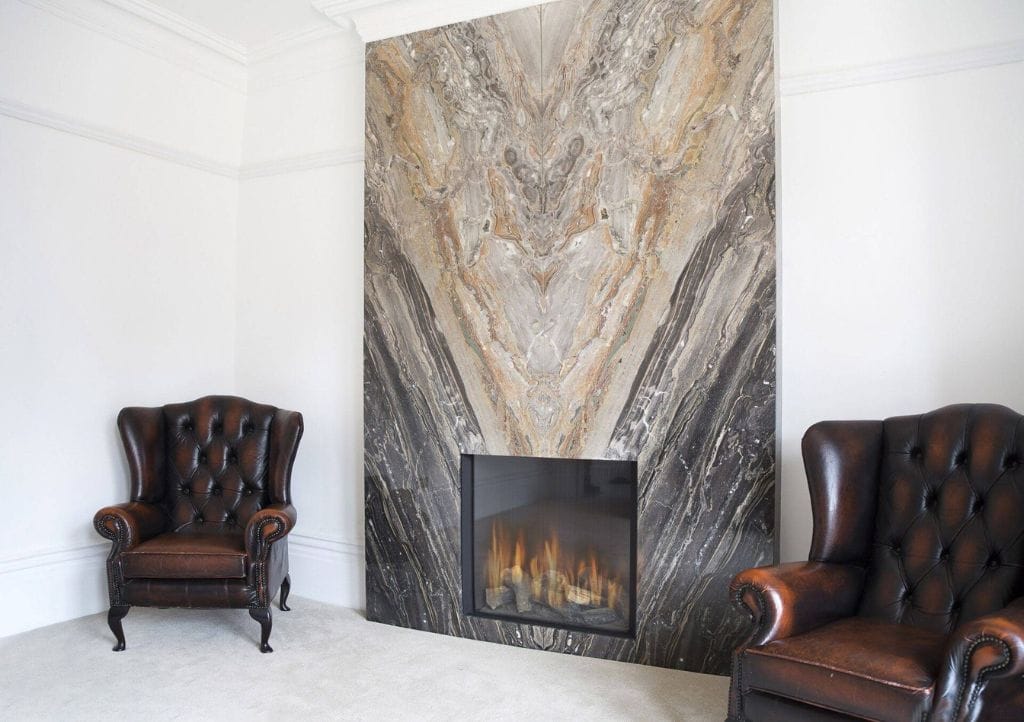
Bookmatched stone makes this even more likely. When two slabs are opened like a book so the veining mirrors across a join, the symmetry gives your brain a pattern to work with. People have told us they can see faces, figures and all sorts in their stone. Really, it’s a reflection of their imagination.
None of that is a reason to avoid natural stone. It’s a reason to know what you’re buying. A client who knows their worktop will look different at different times of day enjoys it. A client who doesn’t know thinks something has gone wrong.
See the layout before it’s cut
The surest way to avoid surprises is to see how your worktop will look before the stone is cut. We offer that as a service.
We scan each slab with our vein matching and 3D layout software, then plan where every piece of the worktop will come from. That lets us line up the veining so it flows across a joint, instead of a strong vein meeting a patch with no vein at all. On a long run that’s longer than a single slab, it makes a real difference to how the finished job looks.

For bookmatched designs, it means you can see how the mirrored pattern will sit before you commit, and decide whether you’re happy with it.
Because every slab has to be scanned, there’s an extra charge for this service, so do ask for it when you’re getting a quote. For a stone with bold veining or a kitchen that needs joints, it’s well worth it. Our Calacatta vs Carrara vs Statuario guide explains why layout matters so much on the whiter, bolder marbles.
Is natural stone right for you?
Natural stone isn’t for everyone, and that’s fine. If you want a flawless, uniform surface, you’ll be happier with quartz or porcelain.
Here’s a simple test. Think about wood. Do you love the knots in a piece of oak, or the way the grain swirls through a walnut burr? Or do they bother you? If they bother you, natural stone probably will too. It’s going to have pits, natural fissures and variation, and no amount of care will make it perfect, because it was never made to be.
Natural stone suits you if you like the idea of having a piece of history in your kitchen, you’re happy to accept its character, and you’d rather have depth and individuality than showroom perfection.
Quartz or porcelain suits you if you want what you see in the sample to be what you get, you’d be bothered by a pit or a resin fill, or you simply want a surface you don’t have to think about. Have a look at our quartz and porcelain ranges.
Whichever way you lean, the most important thing is to be informed before you buy. Most of the problems we see come down to someone being sold a worktop without knowing what it was. If you’re not sure, come and ask us. We’ll talk you through how the stone was formed, how it’s been processed and how it’ll look in your kitchen, even if you don’t end up buying from us.
You can book a visit to our showroom to see full slabs in person, or call the team on 01772 440888.
Natural Stone FAQs
Usually not. Run your fingertip across it. If the surface is smooth and you can’t feel the line, it’s almost certainly a natural fissure. If you can feel an edge, contact your fabricator.
Natural stone has voids and pits that are filled with resin at the factory before the slab is polished. Seeing small resin areas up close is normal.
No. A sample shows the colour, but natural stone varies across a full slab. Always look at the actual slab before it’s cut, and ask about a layout preview if the veining matters to you.
Natural stone has real depth, and minerals such as mica reflect light. As the light changes through the day, so does how the veining and surface appear.
Yes. Small chips can be filled with a colour-matched resin and polished back, and a skilled repair is often hard to spot. A crack is more involved, so speak to your fabricator.
Probably not. If uniformity matters most, quartz or porcelain will give you a more consistent result.


