
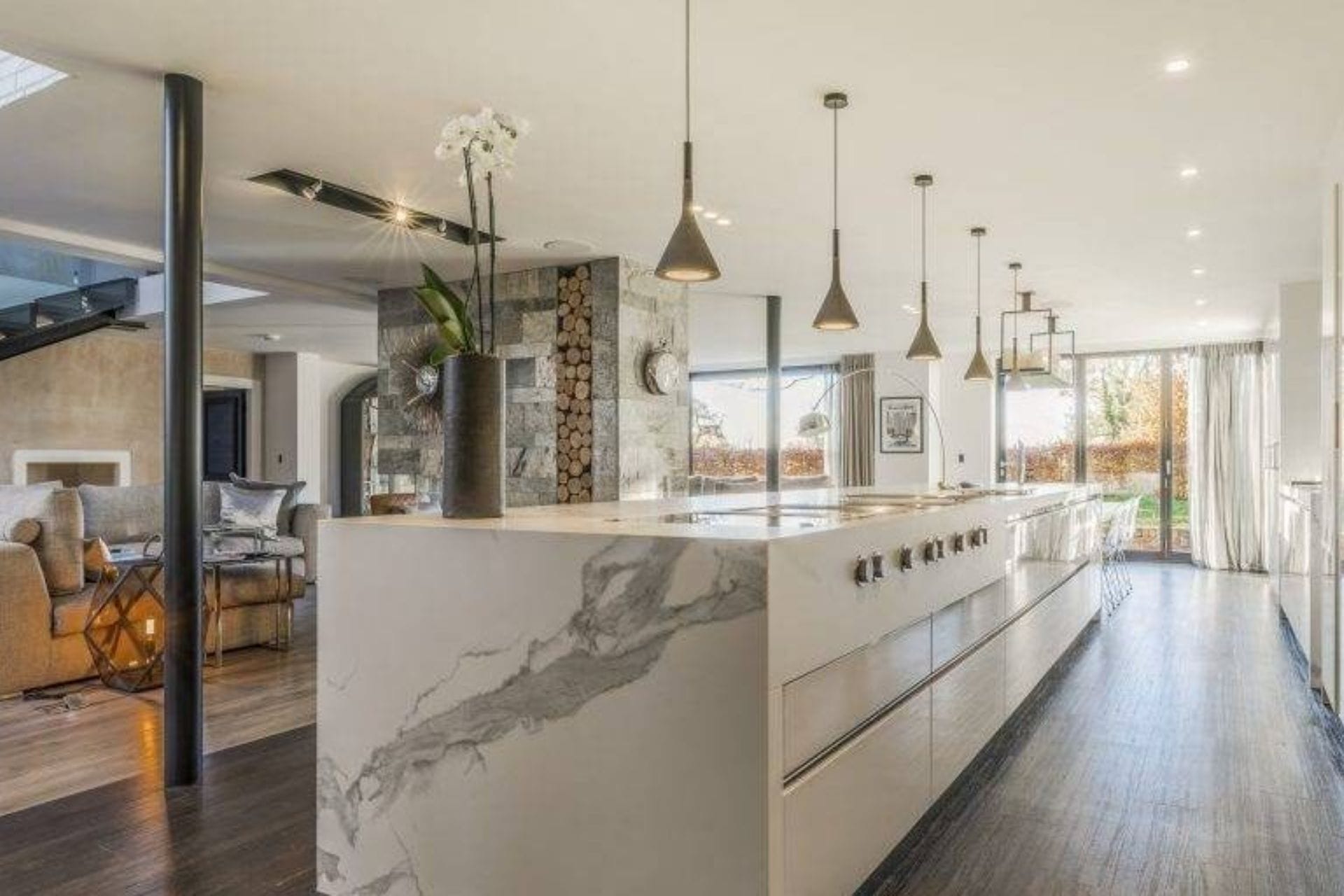
Calacatta, Carrara, Statuario, Arabescato and Nero Marquina are the marble patterns you’ll run into most often, and they get treated as more or less interchangeable, which they aren’t: stand a Carrara worktop next to an Arabescato one and on paper they’re the same thing, white marble with grey veining, but in a real kitchen they’ve got almost nothing in common. One you barely notice. The other you can’t miss.
Those names came off natural marble originally and they’ve carried over into engineered stone, so a marble effect quartz sold as Calacatta should look like Calacatta, which is useful when you’re buying because it means the name ends up doing a lot of the describing for you.
Where it bites is scale. On a metre and a half between the hob and the wall most of these look fine, and you could pick any of them off a sample without much risk, but put the same pattern across a three metre island and the busy ones take over the room while the quiet ones all but disappear into it.
How the five marble patterns compare
| Pattern | Background | Veining | Where it comes from |
|---|---|---|---|
| Carrara | Soft greyish white | Fine, feathery, evenly spread | Apuan Alps, Tuscany |
| Calacatta | Bright white | Thick, bold, well spaced | Apuan Alps, Tuscany |
| Statuario | Very white | Bold, dramatic, sparse | Apuan Alps, Tuscany |
| Arabescato | White | Thick veins forming a net | Apuan Alps, Tuscany |
| Nero Marquina | Deep black | Sharp white, often angular | Markina, Basque Country |
Where they come from and why they look so different
All five started life on a seabed. Marble is limestone that’s been cooked, and limestone is what you get when the shells and skeletons of sea creatures pile up on the bottom of an ocean for long enough to compact into rock. The Italian four were laid down in the Tethys, an ocean that doesn’t exist any more.
What turned that limestone into marble was a continental collision. As the Adria plate ground into Europe and shoved up the Apennines, the limestone was buried, heated and squeezed hard enough that the calcite in it recrystallised into the dense interlocking crystal you’re looking at on a polished slab.
Calcite on its own is white, so the whiteness isn’t something that was added. It’s what’s left when there’s nothing else in there. Statuario is the whitest of the group because it’s the purest, close to all calcite and very little else, which is why sculptors wanted it.
Everything you can see in the veining is impurity, other minerals that happened to be sitting in the original sediment. Iron sulphide gives you dark greys and blacks. Muscovite, a potassium mineral, gives golden tones.
The patterns differ because of how those impurities were arranged and what happened to the rock afterwards. Fine impurity scattered evenly through the sediment gives you Carrara’s soft diffuse feathering. Impurity concentrated along fractures and bedding gives you the bold separated veins of Calacatta and Statuario.
Arabescato is a breccia, meaning the rock was shattered by tectonic movement and then cemented back together over millions of years as mineral deposits filled the gaps, so the veins in an Arabescato slab are those filled fractures. The pattern looks like a net because that is what it is, the joins between broken pieces of the original stone.
That is how four of these come out of the same mountains and still look nothing alike. Carrara, Calacatta, Statuario and Arabescato are all quarried across the Apuan Alps in northern Tuscany, sometimes from quarries a few miles apart. They aren’t different stones from different places. It’s the same rock, formed under slightly different conditions.
Nero Marquina sits outside all of that. It’s Spanish, from Markina in the Basque Country, and strictly speaking it isn’t marble: it’s a black bituminous limestone, with the colour coming from bitumen in the rock rather than from anything that happened to it under a mountain. The white veins are mineral deposits that filled cracks later on.

Carrara marble: soft grey, evenly veined
Carrara is the cheapest of the Italian whites and by far the most widely used.
The background isn’t actually white. It’s a soft grey, and because the veining is fine and feathery and spread fairly evenly across the slab, nothing in it really dominates, so from across a room you don’t read it as a patterned surface at all, just a soft grey one with a bit of movement in it.
It’s an easy stone to live with. It won’t argue with your cabinets and it copes with a kitchen that’s already got plenty going on. If you want marble without the drama, this is it.
The quartz versions we hold are QZ101 White Carrara, Carrara by Stone Italiana, Compac Unique Carrara and Compac Carrara.
Calacatta marble: bright white with bold veining
Calacatta is a step up from Carrara in every direction. Brighter white to start with, and the veining is thicker and further apart, with clean stretches of white in between. Plenty of Calacattas have gold or beige running through the grey, which is where Calacatta Oro and Calacatta Gold get their names.
In natural stone it’s rarer than Carrara and the price follows, and it’s a bigger decision in the kitchen too, because a Calacatta island is the first thing anyone sees when they walk into the room, which is usually the whole point of choosing it but does mean you want to be sure before the order goes in.
It’s the pattern we stock most of by a distance. Thirteen slabs in our marble effect range are Calacattas, including Caesarstone Calacatta Nuvo, Silestone Eternal Calacatta Gold, Compac Unique Calacatta Gold, Calacatta Oro and Lumina Calacatta Champagne. Compac Unique Calacatta Black does the same thing in reverse, on a dark base.
Statuario marble: the whitest and the rarest
The name comes from statuary, which is what this one was quarried for.
It’s the whitest of the group, near enough true white, with long bold grey veins running across big clean areas of stone. Less pattern overall than Calacatta, but what’s there hits harder. It’s also the dearest.
All that clean white is unforgiving. A joint landing in the middle of an empty stretch has nothing to hide behind, and a vein that runs off the edge of one slab and doesn’t pick up on the next is obvious from the doorway, so Statuario is the one where slab layout needs proper time before anything gets cut.
In quartz: Silestone Eternal Statuario, Caesarstone Statuario Maximus, Caesarstone Statuario Nuvo, Compac Unique Statuario and three Lumina versions including Statuario Mirage.
Arabescato marble: interlinked veins in a net pattern
Arabescato’s veins don’t run one way. They interlink and loop back on themselves, so what you get is closer to a net laid over the white. Thick veins, and the white spaces between them all different shapes and sizes.
It’s the most distinctive of the whites and not everyone likes it. On a splashback or an ordinary run of worktop it looks brilliant. Spread across a very large island it can get busy.
We hold three: Infiniti Stone Arabescato Shimmer, Arabescato Michelangelo Lux and Compac Unique Arabescato.
Nero Marquina marble: black with sharp white veins
The reverse of everything above: black stone with sharp white veins running through it.
Those veins are more angular than anything in the Italian whites, more like cracks than feathers. It’s a strong look and it works best when it’s obviously deliberate, as an island top against pale units or one run of worktop in a kitchen that’s light everywhere else.
We stock Compac Unique Marquina and Silestone Eternal Marquina. If you want black with something warmer in it, Compac Unique Portoro swaps the white veining for gold.
How the patterns translate into quartz
The names come across intact. The material doesn’t behave the same way though, and there are a few things to know before you order.
The pattern repeats. Marble veining is geology, so no two natural slabs are the same. Quartz is made, so the pattern comes round again over a set distance. On a short worktop you’ll never spot it. On a long run or a big island you might, so ask to see a full slab and not a sample.
Veining depth isn’t the same across products. Some quartz carries the veining right through the body of the slab and some only puts it near the surface, and on a flat worktop nobody could tell you which is which, but it shows up straight away on mitred edges and waterfall ends, where you’re cutting at an angle and the veining has to keep going down the side without looking like it’s been printed on. If either of those is in the design, ask before you order.
You’re swapping uniqueness for repeatability. Natural marble gives you a slab nobody else has got. Quartz gives you one you can match again in two years if something gets chipped, and one that won’t etch when a lemon sits on it overnight. Which of those you’d rather have is the actual decision, and we’ve been through it properly in natural stone vs engineered stone.

Which marble pattern should you choose?
There’s no right answer, but there’s a rough order to it. Carrara is the calmest. Calacatta is the one that makes an island the feature of the room. Statuario does the same job and costs more. Arabescato is for anyone who wants something less recognisable. Nero Marquina is there if white was never what you were after.
Whichever way you’re leaning, see the pattern at the size you’re buying it. A postcard sample tells you the colour and nothing at all about the scale of the veining, and scale is most of what separates these five.
You can look through the full marble effect quartz range online, or get in touch if you want to see full slabs before committing.


