
Short version: In a small kitchen, the worktop has more visual influence than almost anything else in the room. It’s one of the largest surfaces, it sits at eye level, and the colour and finish you pick changes how much light bounces around the space. Get that one decision right and you’ve solved most of the problem. Below is how to choose well, plus the other points that genuinely make a difference.
Why the worktop matters more than you'd think
Most small kitchen design guides start with paint and lighting. Both help, but neither does as much work as the worktop. A pale 3-metre run of stone reflects light across the room. A dark, busy one absorbs it. A continuous slab reads as one surface. A bad seam chops the kitchen in half.
We’ve fitted worktops into thousands of UK kitchens since 2005, and we’d back the worktop as the most influential decision in any small kitchen renovation. This guide is weighted that way. Worktop first, everything else after.
Use Of Colour
When clients ask us about kitchen worktop colours for small UK homes, the honest answer is that lighter shades almost always win, but the version of light matters.
There’s room within “light”. Pure flat white can read clinical if everything around it is also white. A soft grey-veined quartz, a veined white quartz, a warm cream or a pale granite with gentle movement usually feels better, because the eye has something to settle on.
The thing to avoid is dark, heavily patterned granite across a main run. It looks beautiful in a showroom and shrinks a small kitchen in a way clients rarely expect. If you love a darker stone, use it on an island top or a splashback rather than running it across the whole worktop.
Using dark stone in a small kitchen
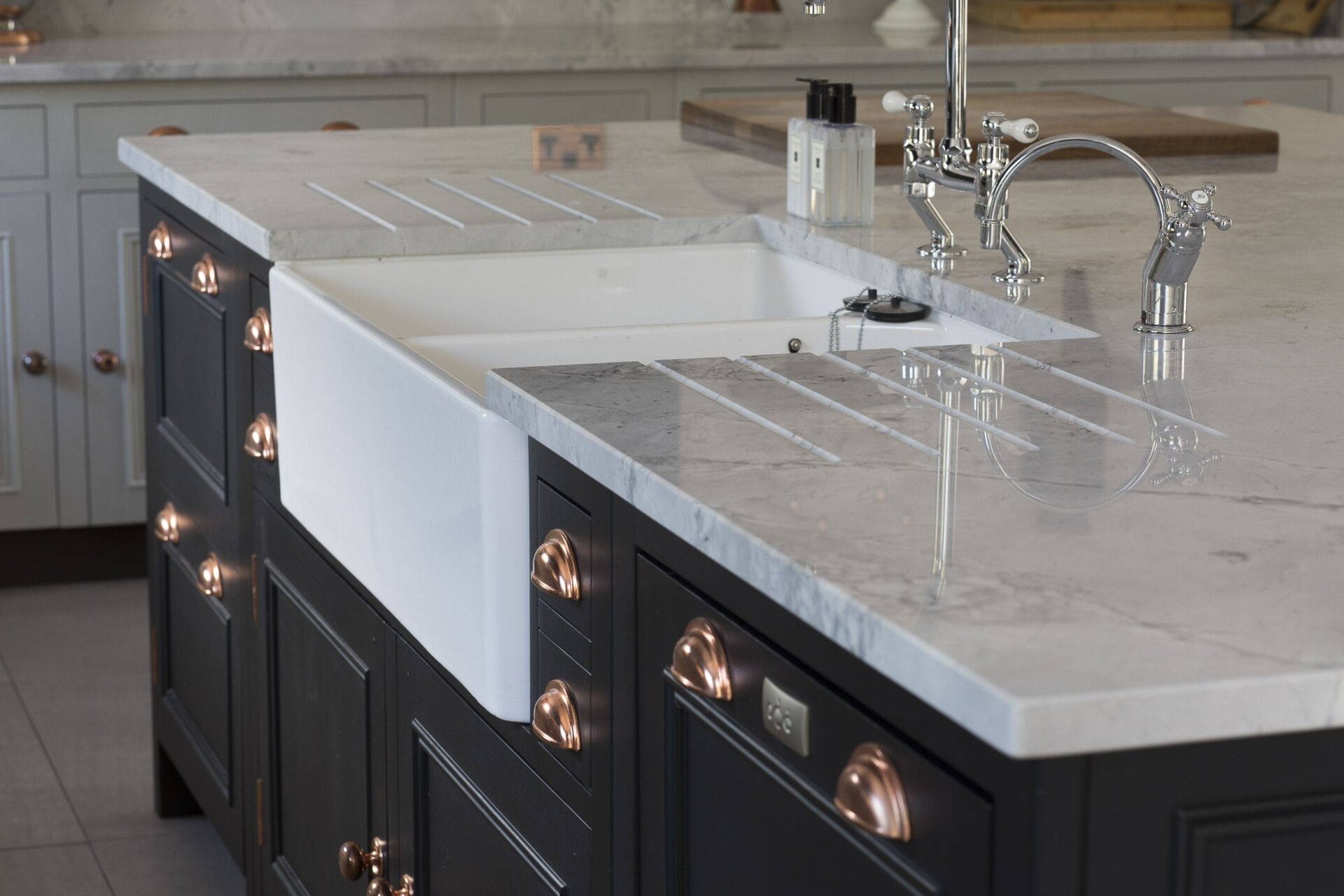
If you love darker stone, the answer isn’t to avoid it. It’s to put it in the right place. A dark island top against light perimeter worktops works. A dark splashback behind a pale run works. A black hob surround framed by a paler stone works. The version that doesn’t work is running the dark stone end-to-end as the main worktop. Concentrate the dark where it’s a feature, not where it’s the field.
Pattern and joins
Long continuous surfaces help. Pattern that runs end-to-end without abrupt shifts reads as more space. High contrast reads as less.
This is where quartz has a small practical edge in galley kitchens. Quartz worktops for small kitchens are made to a consistent pattern, so a long run looks seamless. Granite varies along the slab, and two granite pieces side by side will show a join more visibly than two quartz pieces in the same colour. Granite worktops still work in small kitchens, they just need more thought at the templating stage. Galley kitchen worktops in particular benefit from a consistent pattern, since the eye runs the full length of the room without anything else to break the view.
Splashbacks
Kitchen splashback ideas for small spaces tend to fall into two camps: continuity (extending the worktop stone up the wall) or reflection (glass over a painted surface). Both can work. The mistakes tend to come from mixing them.
A stone splashback that matches the worktop runs the eye continuously from surface to wall, which makes the space feel taller. Breaking it with a different material (tile, glass, painted wall) chops the view and reads as less space.
Glass splashbacks reflect light, which helps in darker kitchens, but a coloured glass behind the hob can dominate a small room more than people anticipate. Clear glass over a painted wall usually reads better than a strong colour.
Full-height splashbacks behind a hob look striking, but in a tight kitchen, they can feel heavy. A standard upstand is often the right call.

20mm vs 30mm
In a larger kitchen we’d often steer clients toward 30mm for the substantial feel. In a small kitchen, 20mm has a real argument for it.
A thinner slab reads as lighter and more contemporary, and the reduced visual weight makes a difference in a compact space. The trade-off is that 20mm can look a bit insubstantial on its own, which is why we’d normally pair it with a built-up mitred edge. You get the slim profile and the solidity at the same time.
Polished, honed or leathered
Most small kitchen worktops default to polished. That makes sense, since polished is reflective and bounces light around. But it’s worth knowing the alternatives.
Honed (matte) reads softer and tends to suit cottage and period kitchens where high gloss feels wrong. Leathered (lightly textured) hides fingerprints and water marks far better than polished. If you’re set on a darker stone and worried about smudges showing every time someone leans on it, leathered is the answer.
Common mistakes we see
After two decades of fabrication and installation, the small kitchen worktop mistakes that come back most often:
- Black polished granite across a galley. It looks incredible in the slab yard. In a 2.5m galley with one window, it eats the light and the kitchen feels half its size.
- Picking from a tiny sample for a long run. Granite varies. On a small kitchen where every metre is visible, a sample the size of a phone tells you almost nothing.
- 30mm in a compact contemporary kitchen. Often the wrong call for the style. A 20mm slab with a mitred edge usually serves better.
- A dramatic marble-look quartz used everywhere. Beautiful in moderation, overwhelming when it covers every horizontal surface. Use it on the island or the splashback, not both.
- Skipping the in-person slab view to save a trip. A small kitchen has less room for surprises. See the actual piece before it’s cut.
Kitchen Islands
Clients ask about kitchen islands a lot, so worth being honest. As a rough rule, an island needs about a metre of clear floor on every side to feel comfortable. In most genuinely small kitchens that space isn’t there, and a cramped island creates pinch points and clutter rather than the open social space people picture.
A peninsula off a run of cabinets usually does the same job with far less visual impact. A slim breakfast bar or a freestanding table also works. If you’ve been told an island will fit and it’s nagging at you, that instinct is usually right.
Planning a renovation?
The worktop is the decision that affects the most in a small kitchen renovation: light, flow, sense of space. Worth seeing full slabs in person before you commit, particularly for granite, where samples don’t tell the full story.
We’ve worked on small kitchens across the UK since 2005, from terraced-house galleys to compact city flats. If you’d like an honest steer on what would work for your space, get in touch with us today


